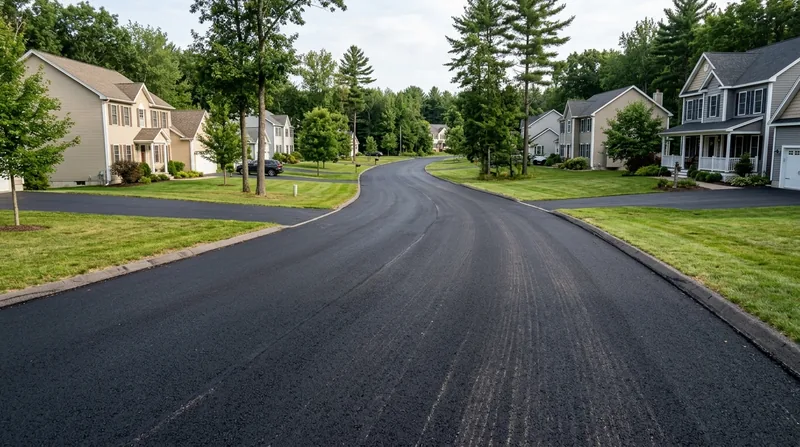




Private Road & HOA Paving in Syracuse demands a base built to handle winter plow trucks, spring clay saturation, and the rolling terrain of the Capital Region. Subdivisions across Syracuse, Liverpool, Clay, and Cicero depend on roads that stay passable year-round, and that means sizing the asphalt and base for the weight and freeze-thaw cycles that define Central New York winters. We coordinate phased paving across developments so residents maintain access throughout the work, and we size every job to the actual soil and traffic load underneath. Unlike a residential driveway, a private road or HOA street carries legal and structural demands that require planning, drainage, and a base engineered for the long haul. Whether you manage a small subdivision in Baldwinsville or a larger HOA community in Camillus or Solvay, we handle the full scope: from base prep and grading to finished asphalt, with written estimates that specify tonnage and thickness so you know exactly what you are paying for.
Why Private Road & HOA Paving Matters in Syracuse and the Capital Region
Private roads and HOA streets in the Syracuse area sit on glacial clay and till soils that absorb water in spring and freeze solid in winter. A driveway that is four to six inches thick may hold fine for a single family car, but a road that carries plow trucks, salt spreaders, and twenty or more resident vehicles needs a stronger base and a thicker wearing course. Spring thaw is the critical stress point: as the ground unfreezes and clay saturation peaks, an undersized base fails rapidly, and patching becomes a losing game within two seasons. The cost of rebuilding a failed road after just a few winters far exceeds the cost of building it right the first time.
- Spring thaw and clay saturation damage roads with shallow bases faster than anywhere else in the Northeast.
- Plow trucks and salt spreaders apply concentrated loads that residential asphalt is not designed to carry.
- Proper base sizing prevents alligator cracking and rutting that make roads unsafe and expensive to repair.
- Phased paving lets residents keep access to their homes and driveways while work is underway.
- Written tonnage and thickness specs protect both the HOA and the contractor from disputes about what was delivered.
Roads that are built to spec hold for ten to fifteen years before resurfacing becomes necessary, saving the HOA thousands in emergency repairs and special assessments.
Key info: New York State requires utility locates before any excavation. Before we grade or prepare a base for a private road, we file a locate request with 811 to mark gas, electric, and water lines. HOA boards should verify that all utility companies have marked their lines before work begins, and should confirm permitting requirements with the town or village building department, as rules vary across the Capital Region.
How We Plan and Execute Private Road & HOA Paving in Syracuse
Every private road job starts with a site visit and a conversation with the HOA board or property manager. We measure the road, evaluate the existing base and drainage, and assess soil conditions. From there, we develop a phased schedule that keeps at least one lane passable for resident access, and we specify the base material, thickness, and asphalt tonnage in writing before any work begins. On larger subdivisions like those in North Syracuse and Clay, we often mill and overlay the existing surface to save cost, or we remove and replace the base if the road has failed structurally. The goal is a smooth, durable road that handles winter traffic and spring thaw without premature failure.
- We measure the road and evaluate soil bearing capacity, drainage, and existing base condition on site.
- We develop a phased work schedule with the HOA so residents keep access to homes and driveways.
- We specify base material, asphalt thickness, and tonnage per linear foot in a written estimate.
- We grade and compact the base to proper slope and elevation, proof roll for stability, and then pave.
- We coordinate with the town or village on any required permits and with utility companies on line locates.
- We clean up and restore the shoulder and drainage after paving is complete.
The result is a road that the HOA can rely on for a decade or more without costly surprises or special assessments for emergency repairs.
Example: A Saratoga subdivision with thirty homes and two miles of internal roads needed base repair after a failed winter. We milled the top two inches of existing asphalt, hauled it away for recycling, rebuilt the base with stone and proper compaction, and paved a new three-inch wearing course. Phased work kept the main access lane open, and the job took three weeks. Cost was roughly $45,000 for the full scope. The road now handles winter traffic without rutting or cracking.
Private Road & HOA Paving Methods and Approaches
The method we choose depends on the road condition, budget, and how much disruption the HOA can tolerate. A road with a sound base but a worn surface is a candidate for mill and overlay, which removes the top layer and replaces it with new asphalt. A road with a failed base needs full-depth removal and replacement, a larger project that takes longer and costs more but delivers a road that will last. Gravel roads can be upgraded to tar and chip or recycled asphalt millings, a lower-cost option for rural or low-traffic private lanes. The estimate will specify which approach makes sense for your road.
| Approach | Description | Best for |
|---|---|---|
| Mill and Overlay | We remove the top 1.5 to 2 inches of existing asphalt, recycle it, and pave a new 2 to 3 inch wearing course on the existing base. | Roads with sound bases but worn or cracked surfaces. Faster, less disruptive, lower cost. |
| Full-Depth Removal and Replacement | We remove all existing asphalt and base, haul it away, rebuild the base with new stone and proper compaction, and pave a new road from the subgrade up. | Roads with failed bases, severe rutting, or drainage problems. Most durable, most expensive, takes longer. |
| Recycled Asphalt Millings | We grade and compact a base, then spread recycled asphalt millings and compact them. The millings bind over time and form a solid riding surface. | Rural private lanes, low-traffic roads, budget-conscious HOAs. Lower cost upfront, requires annual maintenance and topping. |
| Tar and Chip | We apply a liquid asphalt binder to a prepared base and broadcast stone chips, then compact. The result is a bound stone surface that resembles crushed rock. | Rustic or rural roads where appearance matters, moderate traffic, budget constraints. Durable but not as smooth as hot asphalt. |
We recommend getting a site estimate before choosing a method, because the right approach depends on what is underneath and how the road has failed. A resurfacing or overlay can extend the life of a good base by ten years, while a full replacement is the only answer if the base has failed.
Private Road & HOA Paving Cost in Syracuse: What to Expect
Private road paving in the Syracuse area typically starts at around $15,000 for a small subdivision entrance or a short section of road, and scales up rapidly with length, width, and base condition. A full two-mile road with a failed base and complete replacement can run $50,000 to $100,000 or more, depending on soil conditions, drainage work, and whether the road is straight or has curves and elevation changes. The main cost drivers are the length and width of the road, the depth and condition of the base, whether you are overlaying or replacing, and the complexity of drainage and grading. A mill and overlay of an existing two-lane road is less expensive than full removal and replacement, and recycled asphalt millings cost less than hot asphalt but require more maintenance.
We provide a written estimate that breaks down the cost by phase, specifies the tonnage of asphalt and base material, and explains what is included at each price point. The estimate is free and comes with no obligation to book. Many HOAs find that getting two or three estimates helps clarify the scope and the trade-offs between methods. If the road is long or the base condition is uncertain, we recommend a site visit so we can evaluate soil and drainage before giving a firm number.
For detailed pricing on our full range of services, including private roads and HOA paving, visit our pricing page or call us at (315) 951-8102 for a free estimate.
Private Road & HOA Paving Near Me: What Syracuse Homeowners and Property Managers Should Know
When you are hiring a contractor for private road or HOA paving, the first step is to verify that the contractor is fully insured and can provide proof of coverage. The second is to get multiple estimates so you understand the range of approaches and pricing. Ask each contractor to specify the base material, asphalt thickness, and tonnage in writing, and ask for references from other HOAs or property managers they have worked with. Be cautious of any contractor who arrives unsolicited, demands a large cash deposit upfront, or quotes a price that seems too good to be true. Legitimate local contractors have a local address and local vehicles, and they are willing to answer detailed questions about method and materials.
Your HOA board should also verify with the town or village building department whether a permit is required for the road work, and confirm any architectural or design standards that the HOA covenants may impose. Some HOAs have specific requirements about asphalt color, edge treatment, or drainage that the contractor needs to know about before the estimate. If the road crosses utility lines, coordinate with the utility companies to mark their lines before any excavation begins. Finally, ask the contractor about a warranty or guarantee on the workmanship, which is typically one to three years from completion. A reputable contractor will stand behind the installation and will be available to address any problems that arise during that period.
For a free estimate and to discuss your private road or HOA paving project in detail, contact us today or call (315) 951-8102. We serve Syracuse, Liverpool, North Syracuse, Cicero, Clay, Baldwinsville, Camillus, Solvay, DeWitt, Fayetteville, Manlius, and surrounding communities in Central New York.
Private Road & HOA Paving in Syracuse: Pricing Guide
| Service | Price | Details |
|---|---|---|
| Small subdivision entrance or short road section | Starting at $15,000 | Mill and overlay of existing asphalt, one to two hundred linear feet, proper drainage and edging included |
| One-mile private road with sound base, full width mill and overlay | Starting at $25,000 | Removes and recycles top asphalt layer, applies new wearing course, phased access maintained, tonnage specified in writing |
| Full-depth replacement with new base and asphalt, one to two miles | Starting at $50,000 | Removal and haul-away of failed asphalt and base, new stone base with proof rolling, new asphalt paving, drainage work included |
| Recycled asphalt millings or tar and chip upgrade | Starting at $8,000 | Grading, base prep, material application, and compaction for rural lanes or lower-traffic roads, budget-conscious HOAs |
| Complex or large-scale job with site challenges | On estimate | Steep terrain, poor drainage, extensive base failure, or roads over one mile require site evaluation before pricing |
| Free estimate | No charge | Response within 24 hours at (315) 951-8102, includes site visit, written specs, and no obligation to book |
Indicative pricing, the exact cost depends on square footage, finish, and site access. Free personalized estimate within 24h at (315) 951-8102.


